The Boss Cap Problem: Why Final Bosses Are Getting Easier as Games Get Longer
There's something fundamentally broken about modern game design, and it's hiding in plain sight at the end of your favorite RPGs. You've spent 80 hours grinding, optimizing builds, and mastering mechanics — only to steamroll the final boss in three minutes flat. The very system designed to reward your dedication has accidentally neutered the climax it was supposed to protect.
This isn't just about one game or one genre. From Elden Ring's Radagon fight feeling trivial after extensive exploration, to Cyberpunk 2077's Adam Smasher crumbling under properly leveled V, to The Witcher 3's Wild Hunt anticlimactically folding to an overpowered Geralt — the pattern is everywhere. The more you engage with these games as intended, the less satisfying their conclusions become.
The Math Problem That's Killing Climaxes
The root cause lies in how developers approach difficulty scaling versus player progression. Most modern RPGs use what's essentially a linear difficulty curve against exponential player growth. Enemy stats increase at a steady rate while player power compounds through levels, gear, and skill synergies.
Take Horizon Forbidden West as a case study. Aloy's damage output can scale dramatically through weapon modifications, skill trees, and legendary gear — but story bosses remain locked to specific stat ranges to ensure all players can complete the narrative. The result? Players who've engaged deeply with the game's systems find themselves one-shotting encounters that should represent the ultimate test of everything they've learned.
FromSoftware understood this problem when designing Sekiro. Rather than relying purely on stat scaling, they built final encounters around mechanical mastery. The Sword Saint Isshin fight demands perfect deflection timing and pattern recognition that can't be solved through overleveling. You can't grind your way past the skill requirement — and that's precisely why it works.
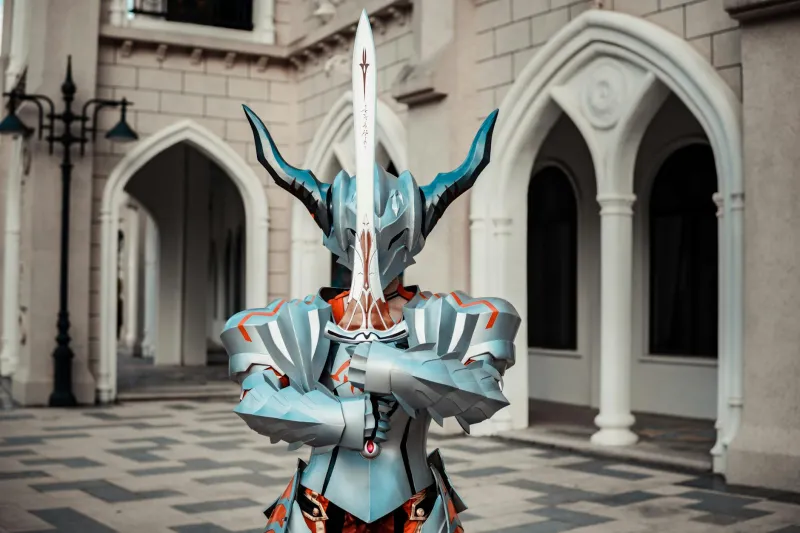
 Photo: Sword Saint Isshin, via www.darksword-armory.com
The Engagement Penalty
What makes this particularly frustrating is that it punishes exactly the behavior developers want to encourage. Studios spend millions crafting intricate progression systems, side quests, and exploration rewards — then accidentally make engaging with those systems detrimental to the core experience.
Final Fantasy XVI exemplifies this contradiction. The game's fantastic combat system encourages experimentation with Eikon abilities and combo mastery, but players who fully explore this depth find themselves trivializing boss encounters that were clearly designed around baseline progression expectations.
Square Enix has started addressing this in recent titles through adaptive difficulty systems, but the implementation feels like a band-aid rather than a fundamental design solution. Final Fantasy VII Rebirth attempts dynamic scaling, but it creates the opposite problem — players feel like their progression doesn't matter when enemies rubber-band to match their power level.
The Nintendo Solution
Nintendo has quietly cracked this code in several recent releases by designing around player agency rather than raw statistics. Tears of the Kingdom's final encounter with Ganondorf scales based on completed shrines and story progression, but more importantly, it's designed to accommodate wildly different approaches.
A player who's mastered the physics system can trivialize the fight through creative engineering, while someone who's focused on traditional combat faces a more conventional but appropriately challenging battle. The fight adapts to how you've chosen to engage with the game's systems rather than punishing you for engaging too deeply.
Metroid Dread takes a different approach entirely. Samus's power growth is carefully gated, and the final boss is designed around her complete moveset. There's no way to "overpower" the encounter because acquiring new abilities is mandatory for progression. The challenge comes from execution under pressure, not from managing an arbitrary power curve.
The Completion Rate Reality Check
Perhaps most telling is what achievement data reveals about player behavior. According to publicly available PlayStation trophy statistics, games with notorious "boss cap problems" show dramatic completion rate drops in their final hours. Assassin's Creed Valhalla sees only 23% of players who start the game actually finish the main story — and anecdotal evidence suggests many who do report feeling underwhelmed by Kjotve's final confrontation after 60+ hours of power accumulation.
Contrast this with God of War Ragnarök, where 47% of players complete the main story. Santa Monica Studio carefully managed Kratos's power growth to ensure the final encounters with Thor and Odin feel appropriately climactic regardless of how much optional content players have consumed.
Designing Around Investment, Not Against It
The solution isn't to cap player progression or implement rubber-band scaling. Instead, developers need to design final encounters that become more interesting as players grow stronger, not easier.
Nier: Automata demonstrates this beautifully. The game's multiple endings and shifting mechanical focus mean that player mastery opens up new layers of challenge rather than trivializing existing ones. A fully upgraded 2B doesn't make the game easier — she makes it different, revealing mechanical depth that was previously inaccessible.
Similarly, Hades uses its roguelike structure to ensure that player progression enhances rather than undermines the challenge. Zagreus getting stronger means facing tougher enemy combinations and more complex encounter designs. The difficulty scales with player investment in a way that feels natural and rewarding.
The Path Forward
The industry needs to stop treating final bosses as stat checks and start designing them as skill celebrations. The climax of an 80-hour RPG should feel like a masterclass in everything that game has taught you, not a victory lap against an enemy who gave up trying.
This means building encounters that scale mechanically rather than numerically, designing around player agency rather than arbitrary power levels, and most importantly, ensuring that the players who invest the most in your game get the most satisfying payoff.
The boss cap problem isn't unsolvable — it just requires developers to stop designing endings for the lowest common denominator and start crafting climaxes worthy of the journey that led there.